Showing posts with label review. Show all posts

Sunday, August 23, 2015

"The Interestings" by Meg Wolitzer

So, I just graduated college. While I’m employed and in a job I actually like, I’m not about to miss a perfectly good opportunity to wallow in the post-college blues. So, like any good English major, I decided to find a book to reaffirm these feelings. One google search and trip to the library later, "The Interestings" by Meg Wolitzer found it’s place on my night stand.

And there it sat for almost two months.

While my own summer unfolded, I slowly waded through the intertwining stories of six friends who met at summer camp. The book jumps between the narratives of four different characters and takes place over the span of almost 40 years. As time passes people get sick, people get married, people wallow in post-college blues, but they don’t really change — at least not in any surprising way.

Each character has one or two defining experiences or traits that act as motivators for almost all of their actions. These are labels they can’t seem to shake — and some characters don’t even try to. There’s the ugly but talented boy. The wealthy but kind girl. The troubled but handsome teen. The depressed but big — a baffling trait to place at the center of a character — man. The list goes on. These handful of details form the core of each character in broad, almost rudimentary strokes, defining the course of their lives as they change over the next 40 years. While some go through more extreme changes than others, their future is always foreshadowed long before the reader gets the details of the plot twist. Maybe it’s a rhetorical strategy to keep the reader plodding away, but it also seems to hint at the idea of a type of predestination. The book seems interested in the idea that some people are bound for fame while others for mundane 9 to 5 jobs. The order of this inflexible world is determined by the almost mythical force: “talent.”

Talent, a central part of the art camp that brought the six friends together, is treated differently by each character — sometimes worshiped, sometimes cultivated, sometimes shyly brushed aside. But ultimately, Woltizer seems very cynical about “talent,” especially considering she wrote her first published book as an undergrad. None of the characters find happiness in talent or at least not complete happiness. The characters who find any satisfaction are the ones who are willing to settle for less and compromise on the dreams of their 15-year-old selves. In another words, they discover they are not special, despite what they’ve been told, and nor are they exempt from the disappointments of life.

The book takes a long meandering path to get to this point, however. Along the way, Woltizer asks the reader to spend time with characters that sometimes feel less than dynamic, as if each character is made out of a couple connect-the-dots points but no one actually bothered draw the line between them. The same descriptions of the characters pop up again and again adding little additional information or flesh to the skeletal sketch. I think it would be a safe bet that the reader would remember Cathy’s apparently key traits after the third time she was described as “needy” and large breasted. And after the seventh time, the reader probably has begun to wonder if Cathy is really anything more than a disembodied pair of very demanding boobs.


Mammary glands aside, the book builds an in-depth look into the lives of people who think they’re interesting. Maybe the two-dimensionality of these “interesting” people is a way of damning their own self-importance, but nevertheless it’s hard to spend hours with characters that don’t feel like fully rendered humans. The writing style is clean and plot picks up some of the character’s slack, but, as the title suggests, this is a character driven book and the characters, well, just aren’t that interesting.

Wednesday, May 30, 2012

"The Setting Sun" by Osamu Dazai


            I like the fantastic, I like the surreal, and lately I’ve found myself drawn towards reading a lot of this type of fiction.  In order to continue enjoying the weird, however, I find I need to occasionally take a break and read something realistic.  Nothing is magical if everything is magical.  This is where “The Setting Sun” by Osamu Dazai comes in.

            Let’s look at some facts surrounding this book:
Osamu Dazai: a cheerful bloke
  1. Written in Japan
  2. In 1947
  3. Two years after the end of WWII
  4. By an author who, to this day, is very popular in his home country
  5. He also successfully committed suicide
  6. In 1948
  7. This was at least his fourth suicide attempt

            Unsurprisingly, this was not a cheerful book.  It was a fascinating look into the decline of individuals, a family, an era.  It’s much more than a simple family drama, however.  It’s a crisis, sometimes subtle lurking just beneath the characters’ words and sometimes overt and existential.  Society is breaking and those who have based their whole lives around its existence are also fracturing. It’s a deeply emotional work yet it fortunately never crosses the boundary into melodramatic.

            The cultural barriers this book poses to a western audience, myself included, cannot go unnoted.  Aside from the first 200 pages of “Battle Royale,” this is the first Japanese novel I’ve read though, even with my limited experience in the world of Japanese literature, it was actually quite accessible.  I was at times rather bothered by the naivety and helplessness the female characters displayed throughout the book, but to make the claim of misogyny would be unfair since the male characters, though in very different ways, were equally as flawed.  As for the translation, I was reading Donald Keene’s version which I believe is the only English translation available.  I found it to be very crisp and clear though there were occasionally some word choices, such as some outdated colloquial phrases, that felt out of place.  Though I imagine the prose was likely better in Japanese, the translation is more than serviceable

            Dazai has written a stunning book that, 60 years later and an ocean and a language away, is still powerful.  The building desperation of the characters is captivating and the novel’s latter half is especially brilliant.  To my knowledge, “The Setting Sun” has never achieved widespread popularity in the English-speaking world which is a shame since it’s truly a great work.

Sunday, May 27, 2012

"The Bloody Chamber" by Angela Carter


            When I posted on my Goodreads account that I was reading the short story collection “The Bloody Chamber” by Angela Carter, one of my friends commented, and I quote, “lol you would read something like this (if the title gives any clue).”  I find this comment disturbing.  Very disturbing.  It is, however, with relief tinged regret that I must say she was wrong.  “The Bloody Chamber” wasn’t really for me.

           Don’t think this conclusion is some sort of knee jerk reaction against her comment either.  Truth be told, I really wanted to like this book.  A professor for a class in magical realism I took compiled a massive list at the end of the semester of recommended reading.  I picked up “The Bloody Chamber,” among other books, off of his recommendation.


            And I can see why he recommended it.  The book in many ways is excellent.  It’s an assortment of re-imagined fairy tales from “Beauty and the Beast” to “Little Red Riding Hood.”  These aren’t the Disney, child friendly adaptations either.  It’s graphic, both violently and sexually, though it never feels gratuitous.  Instead, these aspects serve to make these tales more relevant to modern life and values in addition to being an integral part to some of the feminist undertones that pervade the book.  Feminism often gets a bad wrap, but I feel in this collection it’s handled tastefully in the sense that men are not demonized but rather women are empowered.


            The most notable aspect of the book is the breathtaking prose.  At many points I felt like I was reading a raunchier Edgar Allan Poe.  Though it was written in the 1970s the prose feels much older and richer than many books written during that era.  Here’s a sentence taken at random:
“The lucidity, the clarity of the light that afternoon was sufficient to itself; perfect transparency must be impenetrable, these vertical bars of a brass-coloured distillation of light coming down from sulphur-yellow interstices in a sky hunkered with grey clouds that bulge with more rain.”
The whole book flows with that type of vivid complexity of description.  Each sentence is beautifully crafted and is very effective in creating a tangle of atmosphere and tension.


            The problem comes in, however, when that tension breaks.  It feels wrong to criticize a book of re-imagined fairy tales for their plot, but the mastery with which Carter handles the build up and climaxes of these stories is absent from most of the resolutions.  Often ending abruptly or with a broad overview of the future for the characters that is jarring after the slow pace of the rest of the story, it left me unsatisfied after an otherwise wonderful story telling experience.


            Otherwise, this collection has everything going for it, which is why it puzzles me that, all in all, I didn’t love this book.  I didn’t hate it either.  I appreciated Carter’s story telling ability but I found myself many times flipping to the back of the book to see how many pages I had left.  Perhaps I wasn’t in the mood for a primarily plot driven book.  Perhaps reading a short story collection on a plane ride isn’t a good idea.  Perhaps just coming off the stress of finals I should have picked up a lighter read.  But despite my only mild enjoyment of this collection, I really don’t think it’s deserving of a negative review.  In fact I wholeheartedly recommend it to anyone who wants engaging stories woven with fantastic prose.  As for my personal favorite story in this collection, I’ll have to go with “Puss-in-Boots” which, largely due to being told from the point of view of the cat Puss himself, is hilarious.

Saturday, August 20, 2011

The Alchemist


            After my favorable experience with Jorge Luis Borges I decided to try another South American author.  I’ve seen Paulo Coelho’s work around a lot so I set about finding one of his novels for sale.  “The Alchemist” is his most popular and widely available book so I determined it would be a good place to start and now, after having read it, I’ve also determined it will be an excellent place to stop.  And in this context excellent is not a compliment.

            The story is about a boy, presumably in his mid to late teens, who is working as a shepherd in Europe.  He has a dream of a treasure at the pyramids and after a conversation with a gypsy and a godlike old man decides that it is his Personal Legend to find this treasure.  Hold on.  What’s this? Did I capitalize “Personal Legend?”  Why would I do such a thing? I mean neither “Personal” nor “Legend” are proper nouns or in “Personal’s” case even a noun.  No, I capitalized “Personal Legend” because it was capitalized throughout the text of “The Alchemist” along with “Soul of the World,” “Language of the World,” and probably a few others phrases that I don’t care enough about to look up.

            A few frivolous capitalizations may seem to be an odd thing to be upset about but these obnoxiously common out of place capitals are a good representation of everything that is wrong with the book.  “The Alchemist” is as heavy handed as any book I have ever read.  The story is an incredibly unsubtle allegory for following one’s dreams, the characters are one dimensional devices, only the most basic of words are used, the sentences are as inelegant and infantile as something one would find in a first grade reader and the worldview is naively simplistic and unbelievable.  Then, after dealing with all those shortcomings, when I see a clumsy pseudo-meaningful phrase decked out with those gluttonous capital letters I feel like chucking “The Alchemist” at a wall. That’s covered with spikes. And on fire.

            Okay, perhaps I’m exaggerating my reaction, but on the whole I found “The Alchemist” to be an incredibly frustrating read.  There is something to be said for simplicity and I’m a big proponent of being straightforward, but this book takes all the downsides of these qualities and weaves them into a preachy tale aimed at the lowest common denominator.  I don’t like to be completely negative so (Actually who am I kidding? I love writing scathing reviews and this love is pretty much the only reason I finished the book, but I refuse to cave into my ugly desires so here is something positive) I found two upsides to this book.  The first is it seems this novella has helped people and no matter my own opinions on the book that is definitely a noble result.  I also have to admit I found the prologue, a re-imagining of the story of Narcissus, to be very enjoyable and thought provoking two pages.

            Overall this book was not for me and as a result I would never recommend it.  “The Alchemist” is, however, an “international bestselling phenomenon” as the cover so boldly proclaims therefore someone, somewhere out there must think this book is pretty great.  Whoever that is I don’t think I’ll be ever be able to understand so... three cheers for diversity I suppose.  Or as Paulo Coelho would put it: Three Cheers for Diversity.

Wednesday, August 17, 2011

Ficciones


            I’ve started and restarted writing this post several times now and I just can’t express what I want to say eloquently so I’m going to throw back-story, hooks, analogies and whatever other devices I overuse out the window and get to the point: Ficciones by Jorge Luis Borges is good. Really good.

There's something intangibly wonderful
about well worn books.
            Borges was an Argentinean 
writer active in the 20th century and best known, at least in the United States, for his short stories.  His first collection to be translated out of its original Spanish and into English was Ficciones.

            Going into Ficciones I expected the pieces to be rather similar to many other short stories I’ve read: something about a person struggling to overcome an obstacle and then in the end the protagonist has a revelation or grows in some minute way.  Though echoes of this type of structure exist in several of Ficciones stories, individual human actions are not the main concern of this collection.  Borges’ gaze (Figuratively, of course. Borges was blind later in life) is far broader with his stories questioning both reality and perception.

            The unfortunate reality, no matter how Borges might try to twist it, is his stories are far from accessible.  Ficciones though under 200 pages is neither a quick nor an easy read.  Much of this difficulty comes from the ideas Borges plays with in the stories. A real world created from fictional encyclopedias, the implications of rewriting a book word for word, the downsides of infinite memory, parallel universes: these aren’t easy concepts grasp and especially not in the many faceted way in which Borges examines them. Subject matter, however, isn’t the only element making these stories difficult to understand.  It’s clear from the collection that Borges is a very intelligent, well-read and scholarly man.  While these are all admirable qualities, they often work to the reader’s disadvantage.  Many of the selections are written in the manner of a highbrow examination of a fictional author’s work with numerous obscure references, proper nouns and needlessly difficult words thrown in for good measure.  The translator might be at fault for some of these extra layers of difficulty but it’s doubtless Borges was responsible for quite a bit of the complexity.  The writing style does succeed at making the story deeper and more intricate, but whether any of Borges already dense stories actually needed this, is a matter of personal opinion.

            I found Ficciones to be one of the most fascinating and perspective altering books I’ve ever read.  Each story forces the reader to think and revaluate realities that are often left unquestioned.  I liked the first half of the collection slightly better than the second but the whole book is filled with gems.  The stories that stood out to me are: “Tlön, Uqbar, Orbis Tertius,” Pierre Menard, Author of the Quixote,” “The Circular Ruins,” “Funes the Memorious,” “Three Versions of Judas,” and “The South.”  If you’re looking for a good but challenging read I heartily recommend Borges.  For those of you unsure if you would enjoy his writings, many of his stories are available online for free and are well worth a try.

Sunday, August 14, 2011

Survivor


            Though the old adage goes “you shouldn’t judge a book by its cover” I like to maintain that a good cover doesn’t hurt. There are some books that just leap off the shelf.  “Survivor” by Chuck Palahnuik with its construction orange cover is one of them. Mix the alarming hue with dotted white lines that show where creases are made in making a paper airplane and embossed letters in the same blinding orange and you have one brilliant and unique cover.  And adages be damned, because brilliant and unique are also the adjectives I would use to describe the contents of this novel.
 
            The details of the plot are best left to be discovered while reading through the book (even the description on the back gives away too much in my opinion) but at its most general the novel is Tender Branson’s narration of his life story into a black box on a crashing airplane.  As the strange dictation circumstances might imply, Tender’s life has been anything but normal.  The whole book is a surreal parody of religion and pop culture.

            As funny as much of the novel is, Palanuik doesn’t hold back on sobering truths.  When the pilot of the airplane is explaining to Tender how to use the black box and when the plane will crash he says to Tender:

“‘You don’t know when the fuel will run out.  There’s always the chance you could die right in the middle of your life story.’
            And I yelled, So what else is new?”

Palahniuk also makes very good use of both direct and clever symbols and parallels to get his point across.  One of the more unique techniques he applies is a backwards page count starting with page 289 and ending with page 1 giving the sense of a countdown.  Style aside, the plot is engaging and the details never cease to be interesting. However, the disturbing zaniness that gives this book its spark and makes it one of my favorite books I’ve read all year, will just as easily alienate people comfortable with books that tell more traditional stories.

            “Survivor” by Chuck Palahnuik is an odd book.  It’s crude, uncomfortably dark and populated with mostly morally vapid characters.  Yet at the same time it’s meaningful, funny and the characters are, in their own way, endearing.  Whether you can reconcile these disparate parts and enjoy the book largely depends on your own degree of oddness.

Tuesday, August 9, 2011

My First Summer in the Sierra


            I recently visited Yosemite and perhaps I’ve watched too many National Park documentaries or accidentally absorbed what my transcendentalist obsessed high school English teacher was telling me, but Yosemite and John Muir are inseparably linked in my mind.  So in celebration of my arrival at the scenic, yet tourist overrun park that would make old John cry himself to sleep at night if he knew one has to fight through Disneyland sized crowds to see a simple waterfall, I decided to buy and read a book by John Muir. “My First Summer in the Sierra” was the one I happened to pick up.

            John Muir, for the uninitiated, was an American naturalist who spent years frolicking in the Sierra Nevada mountain range, and other wild places, chronicling his experiences. His accounts and enthusiasm led to his founding of the Sierra Club in 1892 and also proved instrumental in the creation of the National Park Service.  As someone who generally greatly enjoys national parks I figured I should give Muir a try even though his writings aren’t the type that would generally appeal to me.

            Now I realize I just provided two different reasons for why I read this book, which may seem superfluous (and probably is) but I would argue that you really need some sort of strong conviction to make it through Muir’s account.  That’s not to say Muir’s book is bad because it absolutely isn’t.  There’s a lot to love about it actually.  His writing manages to be accessible without sacrificing his beautiful prose and his enthusiasm is infectious, though he uses a few too many exclamation marks for my cynical tastes.  The difficulty with “My First Summer in the Sierras” is it’s basically 350 pages of description.  There is a small amount of narrative since this is the 1869 diary of the summer Muir spent as a member of a sheep herding expedition, but it appears Muir did very little in his actual job so the account is almost entirely description ranging from the poetic to the scientific.

            If anyone is thinking of reading a book by Muir I urge you to ask yourself why you want to read it.  If you want beautiful passages about nature I would recommend getting a book of collected quotes from Muir because his descriptions are much more meaningful and palatable in small doses, but if you want a taste of who Muir the man was go ahead and try one of his full books.  The side of Muir that is often disregarded in his public profile comes out.  Don’t misunderstand, Muir is not some monster in disguise with a dark history, but reading Muir’s mixed opinions on the Native Americans and even a veiled reference to the recent end of slavery in the nation is fascinating.  My favorite parts are when the usually overjoyed Muir breaks the character history has set for him and starts complaining about something.  The naturalist’s hatred for small black ants and sheep seems to only be surpassed by the disgust he shows towards shepherds. An account from the unfortunate shepherd who spent most of his summer with Muir has the potential to absolutely hilarious.

            “My First Summer in the Sierras” is well written, insightful and an important piece of work.  Despite these positives it’s not a book that will appeal to many people and unless you’re fascinated with how Muir presents himself in an unfiltered form or think works by Emerson and Thoreau make for riveting reads, I would skip it.

Thursday, August 4, 2011

The Road


            I finished “The Road” by Cormac McCarthy awhile back and I’ve been delaying the review because I’m really at a loss as to what to say.  The premise is pretty simple: it’s about an unnamed man and his son surviving in a post-apocalyptic world.  There really isn’t much more that happens.  The boy and man scavenge for food, evade cannibalistic tribes of humans that roam the desolate world, and constantly face death.  The sparse story reflects the meager existence of the two main characters whose worlds start and end with each other.

            Despite the minimalist approach to story, the novel never drags or seems dull.  “The Road” is driven by its atmosphere, which is gritty, dirty and void of hope.  Throughout the whole story I couldn’t help but be reminded of the world in the popular video game “Fallout 3,” an association which unfortunately spoiled the book for me a bit since “Fallout 3” took post-apocalyptia more lightheartedly than this utterly humorous novel.  Though with the topic of the destructive powers of video games aside (I kid, I kid. Video games are great), it can’t be denied that McCarthy really excels at setting the grim tone with his prose.  Much like the story, the writing was simple yet powerful.  The sentences are short and to the point suggesting a rather simplified and animalistic thought process that arose in the wake of civilization’s destruction.

            I have to admit I didn’t completely “get” this book.  I followed the religious and moral undertones well enough, I think, but the end still puzzles me.  I won’t say any spoilers but the final event of the novel is so incongruent with the rest of the occurrences in the novel I’m stuck wondering what it means, if it’s as it seems or if it even occurred in the post-apocalyptic world.  This isn’t a complaint, just a musing.  There’s nothing wrong with a book that makes you think.

            “The Road” is a very human look at the apocalypse, a subsection of dystopian literature that is rarely explored with such mastery.  I wouldn’t say this is an enjoyable read because the subject matter is far too depressing. I also wouldn’t say that a year from now I’ll be thinking back and remembering it’s message often but I do believe this book has the potential to be a memorable read, especially for parents.  The book never quite clicked for me and I don’t know why since it has all the markings of a book I would like.  It’s not a novel I would actively recommend but I wouldn’t try to persuade someone against reading it either.  In the end to most eloquent thing I can say about it is that, “The Road” was okay.

Tuesday, August 2, 2011

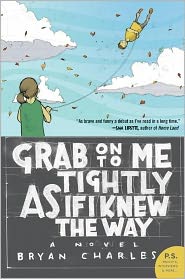
Grab On to Me Tightly as if I Knew the Way


            I promised a review of “Grab On to Me Tightly as if I Knew the Way” by Bryan Charles quite awhile ago but things got in the way and though I finished the book over a week ago I haven’t had time to write a blog on it until now.  I first found this book on a library shelf and I was immediately attracted to its fantastic cover and unwieldy long name.  Acting on these very superficial opinions I checked it out, went home, curled up on a sofa and began to read it.  This is what I found:

            “When you grow up you can be anything, they said, but that’s a lie too.  So I go to band practice and plug in the Twin Reverb, the Stratocaster, and the noise is a beautiful plane crashing into my face.  So I make a gun with my finger and thumb and aim it heavenward.  So I dream of a landscape, this one, darkened by the slow rolling shadows of cloud-sized tits.”

            I don’t like dealing with long quotes but the first paragraph of this novel sums up everything this book has to offer far better than I could say it.  Angst, music, lust.  The three driving themes of this book have been done time and time again by hundreds of different authors but Charles manages to make it seem fresh in no small part due to his writing style.  Every sentence is expertly crafted and I could go to any page at random and pull a tragically beautiful quote out.  

           This is the main reason why (full disclosure time) this isn't the first time I’ve read this book.  It’s been about a year since I first read it and I finally found a used copy of it for sale prompting this recent reread.  Though I loved it the first time, now that I’ve read it again I can easily say it’s become one of my favorite books.

            Despite this, I should acknowledge it’s not a book for everyone.  The basic plot is about 17-year-old Vim Sweeney’s coming to age in early 90’s Michigan.  This means angst and a lot of it.  Vim’s motives aren’t always obvious and he’s not a completely sympathetic character, but that’s really aside the point.  He embodies the turmoil that comes with the empty space on the cusp of adulthood and though his actions are sometimes idiotic, in the end he’s really just a pretty smart, kind hearted, lost kid.  The supporting characters form an interesting and believable cast, each with enough depth to make them more than just flimsy devices to help Vim along with his journey.  Though the writing and cast is sound, this book will probably appeal most to people who were teens in the early 90’s or people who are currently teens. Even if you don’t fit into either of these categories, if you’re in the mood for a good coming to age story I urge you to give this a try because, if nothing else, there are few books with prose as piercing and poetic as this novel offers.  Since I can’t resist I’ll leave you with one final quote:

            “I want to take a ten-year shower.  There is the night to wash off me, all the doubt and dark things lingering.  I feel naked in the brightness now, exposed, like my skin is peeling off and I’m showing her everything, for the first time showing my mother my heart, my fear, the sunken bruises that never heal.”

Sunday, July 17, 2011

Monster, 1959


            I mentioned picking books up on whim in my last review and I guess I just must be in a whimsical mood because “Monster, 1959” by David Maine is another book I read despite knowing nothing about it beforehand.  The basic plot of the book is very well worn monster movie fair.  It starts out with a monster called K living relatively peacefully away from civilization until a group of Americans come to the island and K takes the book’s token “damsel in distress,” Betty.  Her gallant husband, Johnny, along with a group of big game hunters, try to save her leading to plenty of action, the capture of K, and the decision to bring the K to the U.S. (you don’t have to a connoisseur of campy monster movies to know that this move only leads to more disaster).

            Fortunately this flimsy plot doesn’t take itself too seriously and instead works as a vehicle for a few other themes.  In one sense “Monster, 1959” is a tribute to mid twentieth century monster movies.  There’s a bit of tongue and cheek humor, several very unsubtle allusions to movies of the era, and, my personal favorite, the fleshing out of the stereotypical movie characters.  Brave Johnny is addicted to peril to a fault, beautiful and danger prone Betty is actually rather resourceful (though not resourceful enough to save herself), and even the comical 7 foot tall circus clown has his demons.  Maine’s effort to show the other side of these typically one-dimensional characters is interesting but in the end adding one more trait to a very tired character archetype still doesn’t make them any more interesting.  Even the examination of K’s psyche, which seems to have some promise, turns out to be dull and repetitive.

            There are also, surprisingly enough, some very political messages at play within the book.  These messages flit in and out of the narrative both abruptly and infrequently and only occasionally does the author openly mix the story and portrait of the United States he’s painting.  When Maine does this, however, it results in some of the best passages of the book. (WARNING: Spoiler in quote. Granted, the story is so predictable it wouldn’t be hard to guess something like this would take place)
 “The statue [of Liberty], severely foreshortened, looms above them like a Calder mobile.  Like a graven idol: something to worship, to pray to, to die or kill for.  In which case K.’s unexpected figure, squatting atop it, is—a blasphemy? An intrusion? A joke? A logical endpoint?”
 Maine’s story is one really of injustice, which covers everything from the treatment of K to the Tuskegee Syphilis Experiment to commentary on Hydrogen bomb testing.  When he takes a break from the narrative and concentrates on these issues you can see a hint of genius shining through.

            The problem is the rare hint of genius is the best the book has to offer.  Neither the message nor the humor nor the fleshed out characters can overcome the clunky story.  The cliché narrative is both part of the joke and the central meaning of the book but that doesn’t make it any more enjoyable to read.  Many books have covered the same territory far more adeptly and engagingly making there little reason to read “Monster, 1959.”

Tuesday, July 12, 2011

Survival Rates

            Occasionally I choose a book purely on whim.  I’ve never heard of the book or the author before and decide to gamble seven dollars or so on this unknown entity.  I find it refreshing to stumble into a book completely free from expectations and biases with only the information the back cover supplies. Of course, I usually quickly shatter this state by looking it up online about ten pages into the book, but that is beside the point.  I’ve found some great books this way that I otherwise wouldn’t have touched and it’s a practice that I have no intention of giving up anytime soon.


            What I don’t like to mention is that while this method has uncovered some true gems, it is also a very effective way of finding absolutely disastrous books. Both fortunately and unfortunately, Mary Clyde’s short story collection “Survival Rates” falls into neither of these categories.  The Flannery O’Connor award winner is, in my opinion, just okay.

            The nine stories contained within the volume, though each different enough to avoid sounding repetitive, have some definite similarities with each other.  Among the most noticeable is the concentration on the aftermath.  Whether it is coping with a diagnosis or recovering from a breakup each piece gives a glimpse into one, or often several, people’s reactions.  The greatest downfall of the collection is most of the time it is just merely a glimpse and not fully a story.  There is nothing wrong with not having a traditional story arc but by about the fourth story in it begins to seem like this tendency is less of a device and more of a crutch.

            The other main thread in the collection is the southwestern U.S. setting.  There is one set in southern California, another in Utah, but most of the stories with a specified location take place in Phoenix, Arizona or one of its suburbs.  Normally I’m all for a southwest setting seeing as it tends to be woefully unused in literature, but Clyde’s depiction of it leaves a bad taste in my mouth. It’s not that Clyde misrepresents the area; it’s quite the opposite.  The author clearly knows the area very well but for some odd reason seems bent on showing the reader how much of an expert she is by throwing in oddly specific place names.  This is something that can be done acceptably when the story is set in a major city like New York or London but for a place like Phoenix, as large as it might be, the place is really an unknown to people who have never lived there.  I suppose it could be argued Clyde is trying to educate the readers about the city but these efforts occasionally come at the expense of the stories’ clarity.  Because really, how many people who aren’t also intimate with area will know that Smitties is a grocery store or understand all that is implied when a character is described as dressed in clothes from “Biltmore Fashion Park.”

            Despite these complaints “Survival Rates” is by no means a bad collection.  “Victor’s Funeral Urn,” “Pruitt Love,” and “Jumping” are my personal favorites but most of the others in the collection are quite good also.  Each of the stories hover on the edge of greatness and it makes me wish to see another collection by Clyde with her story telling skills better honed.  Seeing as it has been twelve years since the release of her first and only collection this may be the only of her writings the world ever receives which would be a shame because she’s not bad; not bad at all.

Wednesday, July 6, 2011

Franny and Zooey


            “Franny and Zooey” is a book by J.D. Salinger and like all books by Salinger, besides his most famous, can’t be discussed without first establishing the speakers opinion of “The Catcher in the Rye.”  As unfortunate as it is that none of Salinger’s other works can seem to escape Holden’s angst riddled little tale, it’s best to get the elephant out of the room as soon as possible.  I seem to be one of the few people who doesn’t have a strong opinion either way on “The Catcher in the Rye.” I didn’t find Holden annoying, as many other contemporary readers seem to have felt, and generally enjoyed the read, but at the same time the book was not life changing or even made a lasting effect on me as rabid fans claim to have experienced.  Never the less, when one of my friends saw me reading “The Catcher in the Rye” and suggested I should also try “Franny and Zooey” I decided to follow her advice.

            “Franny and Zooey” is about the two youngest members of the Glass family: a fictional family that much of Salinger’s canon concerns, though my only previous encounters with them was through the couple mentions they receive in “Nine Stories.”  The book is in two parts.  The first part is the lead up to Franny’s breakdown and the second is the aftermath told largely through Zooey’s conversations with his mother and Franny.

            The novel has several themes.  Similar to “The Catcher in the Rye” disillusionment with the world and the people who inhabit it plays a large part, but in “Franny and Zooey” the characters are older and their reaction is more mature.  The suicide of the siblings’ eldest brother, Seymour, though it occurred years before the novel’s events, is a definite force in the book making the reader question if the character having a breakdown is really the one in the most distress.  Religion, however, is the most dominant theme.  Salinger, a man who was born Jewish Catholic and went on to practice everything from Hinduism to Scientology in his adult life (more about that here), was known for his ever changing beliefs which are very clearly reflected in this novel.  A pretty strong case could be made that “Franny and Zooey” is actually religious fiction but simply slapping on a label like that wouldn’t do this book justice.

            Salinger’s books get called a lot of things from pretentious to grating, but it can’t be denied that he is a fantastic writer.  His ability to completely change voice, the importance he places in details and his knack for weaving humor and heartbreak together so tightly they can’t be separated, really makes his stories a joy to read.  Despite this, it’s true “Franny and Zooey” isn’t for everyone. The slow pacing and tendency to shy a bit too much towards the oblique side of the spectrum may infuriate some readers, but for people who aren’t bothered by those tendencies, even those who didn’t like “The Catcher in the Rye,” will find a richly rewarding book well worth the time it takes to read its scant 200 pages.

Monday, July 4, 2011

Going After Cacciato


            Tim O’Brien’s “Going After Cacciato,” like many of his other books including his most famous novel “The Things They Carried,” takes place to the backdrop of the Vietnam War.   The book mixes main character Paul Berlin’s memories of the war with Berlin’s and fellow soldiers unreal trek to Paris in pursuit of a deserter, Cacciato.

            The book is far more than a straightforward story, however, so a simple plot summary doesn’t do it justice. The novel I would most readily compare it to is “Catch-22.” Perhaps it reveals how few war based novels I’ve read by being so ready to lump these two books together, but I feel there are some noticeable similarities beyond the theme of war.  Both make some use of chronologically jumbled flashbacks, have dark humor, and express dissatisfaction with war.  The manifestation of this dissatisfaction is where the two books diverge.  While in “Catch-22” Yossarian outright rejects the war and openly tries to escape it, the characters in “Going After Cacciato” are much less decisive.  They cling to the idea they are carrying out their mission of capturing Cacciato despite their march to find him gradually lapsing into tourism.  The lack of decision and definition is a reoccurring theme in this book.  Berlin straddles the line between desertion and mission refusing to commit to either.  Daydreams and reality rub shoulders increasing the confusion.   But confusion is the point: the confusion of the Vietnam War, the confusion of the era, perhaps even the confusion of youth.  In all this confusion the only thing that exists are possibilities but Berlin’s reluctance to capitalize on these give even what normally stand as hopeful beacons a gloom.

            Or maybe I’m just spouting meaningless drivel.  Regardless, I enjoyed “Going After Cacciato.”  It’s the type of book you can examine and reexamine but doesn’t sacrifice an engaging narrative either.  The picture of soldiers on the front cover might scare some potential readers away but even those, like myself, who aren’t war buffs should give this novel a try, because after all, as the mysteriously unaccredited quote on the back of the book said, “To call ‘Going After Cacciato’ a novel about war is like calling ‘Moby-Dick’ a novel about whales.”